
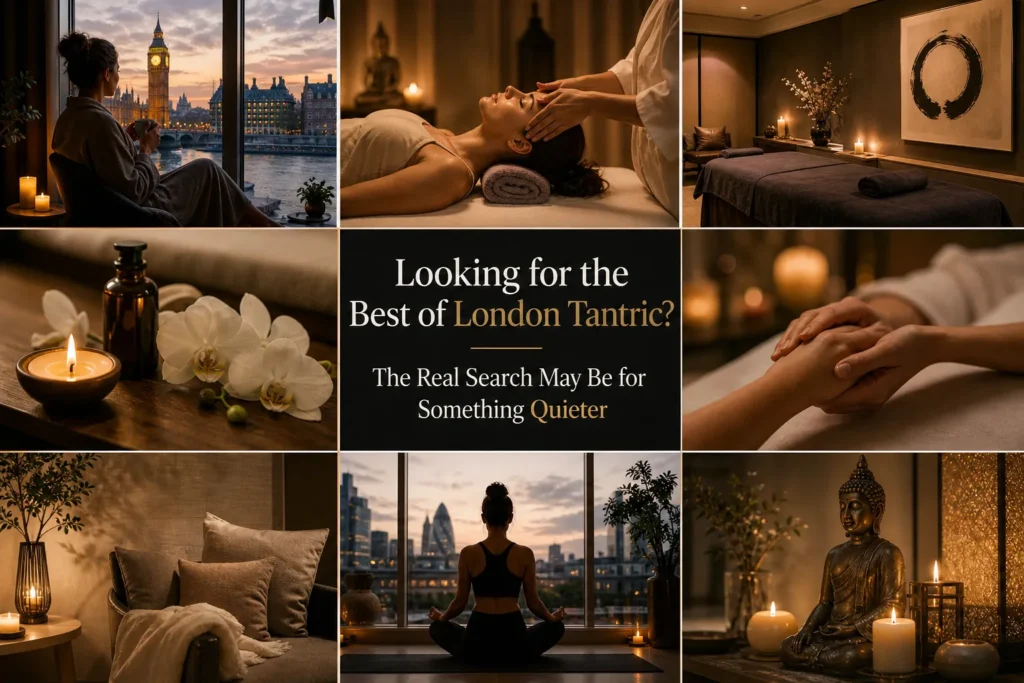
Looking for the Best of London Tantric? The Real Search May Be for Something Quieter
Table of Contents
ToggleWhen Stillness Starts Feeling Luxurious: Rethinking Modern Tantra in London
There’s a particular kind of tiredness that belongs to London.
Not dramatic exhaustion. Not collapse. Something quieter than that.
You notice it on late Jubilee line journeys when people stare through reflections instead of at them. In cafés around Soho where conversations pause every few seconds because someone’s phone lights up again. In the oddly mechanical way many professionals describe their weeks now — productive, efficient, full — while looking emotionally absent from their own lives.
Emotional exhaustion rarely announces itself loudly in large cities.
It accumulates in subtler ways: shallow breathing, overstimulation, interrupted attention, relationships reduced to logistics, bodies treated like transport systems carrying overloaded minds between obligations.
Perhaps that explains why conversations around slowness have changed recently across Central London wellness spaces. Not luxury in the obvious sense. Not indulgence. Something else. A growing interest in experiences that ask people to feel present again rather than merely entertained.
That shift is partly why curiosity around Tantric massage in London has expanded beyond the assumptions people once attached to it.
Not because London suddenly became more spiritual.
Because people became more emotionally overstimulated.
And there is a difference.
The Strange Fatigue of Constant Stimulation
Modern urban life rarely allows the nervous system to settle completely. Even rest has become performative now. People track sleep scores, optimise meditation, document workouts, consume self-improvement in endless streams. Wellness itself sometimes feels exhausting.
Many London professionals are not seeking intensity anymore; they are seeking stillness.
That distinction matters.
For years, wellness culture in the city revolved around productivity disguised as self-care — faster classes, harder routines, biohacking trends, tightly scheduled “recovery.” Yet beneath the polished language sits something more human: people quietly missing softness, slowness, and uninterrupted presence.
A surprising number of conversations around Tantric massage in London begin there rather than anywhere physical.
Not desire. Fatigue.
Not escapism. Nervous-system overload.
You hear versions of it constantly among people working in finance, tech, media, law. Their days involve perpetual responsiveness. Notifications before sunrise. Meetings layered over unfinished thoughts. Constant emotional fragmentation. Even intimacy starts becoming efficient rather than felt.
One wellness practitioner in Marylebone described it quietly during an interview last autumn: “People arrive unable to notice their own breathing anymore.”
That observation stayed with me longer than expected.
Because it wasn’t metaphorical.
Why Slower Experiences Suddenly Feel Unfamiliar
There’s something psychologically revealing about how uncomfortable stillness feels for many people now.
Silence inside a room. No screens. No urgency. No performance.
Even ten uninterrupted minutes of quiet attention can feel unusually intimate to someone accustomed to permanent stimulation.
London has always moved quickly, but recent years altered the emotional texture of the city. Conversations became shorter. Attention spans fractured. Relationships increasingly operate around convenience and exhaustion rather than curiosity. Many people are emotionally available only in fragments now.
And yet the body notices this before language does.
That may explain why some wellness-oriented spaces across the city — particularly those exploring body awareness and mindful touch practices — are becoming less niche than they once were. The appeal often has little to do with exoticism. More to do with emotional deceleration.
A thoughtfully designed tantric massage studio in London is often described by regular visitors less as “luxury” and more as an interruption to overstimulation.
That wording feels revealing too.
People are not always searching for more sensation.
Sometimes they are searching for less noise.
There’s a difference between stimulation and presence, though modern culture rarely separates the two anymore.
London’s Quiet Loneliness
Large cities produce a peculiar emotional contradiction: constant human proximity alongside increasing interpersonal distance.
You can spend an entire week surrounded by people and remain psychologically untouched by any meaningful interaction.
This is especially noticeable among professionals living alone across Central London. High-functioning lives. Impressive careers. Social calendars that appear full from the outside. Yet underneath that movement often sits chronic emotional depletion — not dramatic sadness, simply prolonged disconnection from grounded human presence.
Modern loneliness rarely looks lonely.
It looks busy.
That emotional climate has subtly changed the way people approach wellness environments. Increasingly, individuals seek spaces where they are not required to perform competence, sociability, attractiveness, or productivity for an hour or two.
The growing interest around the best tantric therapists in London often reflects this deeper psychological shift more than most articles acknowledge.
People want environments where attention feels uninterrupted.
Where touch is not rushed.
Where silence is not awkward.
Where the body is treated as something worth listening to rather than managing.
That desire appears repeatedly now in conversations around modern wellness culture throughout London — particularly among individuals who spend most of their lives cognitively overstretched.
A City That Forgot How to Pause
There’s a particular moment familiar to many Londoners: finally arriving home after navigating crowded stations, delayed trains, artificial lighting, relentless conversation, and ambient noise — only to realise your mind continues moving hours later.
The body returns home before the nervous system does.
Perhaps this explains the increasing fascination with slower wellness practices across the city. Not only tantra, but breathwork, sound therapy, somatic practices, sensory reduction environments, digital detox retreats. They all point toward the same cultural pattern: overstimulation has become normalised to the point where calm feels unfamiliar.
Modern wellness often begins where overstimulation finally becomes impossible to ignore.
And unlike older wellness marketing language, younger professionals are becoming sceptical of exaggerated promises. They don’t necessarily want transformation narratives anymore. They want believable experiences. Emotional realism. Grounded calm.
That realism is partly why discussions around Tantric massage in London have become more nuanced recently.
The conversation is shifting away from fantasy and toward nervous-system awareness.
Away from performance and toward embodiment.
Away from spectacle and toward attention.
You can see traces of this evolution in the language wellness-oriented Londoners increasingly use themselves: regulation, presence, emotional grounding, slower touch, sensory awareness, reconnection.
Not trends exactly. Reactions.
What Many People Are Actually Seeking
The internet still misunderstands tantra constantly.
Much of the existing writing feels oddly detached from real human psychology — either aggressively commercial or artificially mystical. Neither reflects how many people genuinely approach these experiences today.
Often, curiosity begins from something surprisingly ordinary.
A relationship feeling emotionally distant despite affection still existing.
An inability to relax physically.
Chronic cognitive overstimulation.
Touch deprivation hidden beneath busy social lives.
A sense that the body has become secondary to constant mental activity.
The most thoughtful conversations around Tantric massage in London rarely centre around spectacle. They revolve around awareness. Slowing down enough to notice tension patterns, emotional fatigue, unconscious guarding, breath restriction, sensory numbness.
One therapist in West London once remarked that many first-time visitors apologise repeatedly during sessions — for not knowing how to relax.
That feels painfully modern somehow.
People have become self-conscious even about resting.
The body absorbs more urban stress than most individuals consciously recognise. Jaw tension. Interrupted breathing. Sleep fragmentation. Hypervigilance disguised as productivity. Emotional fatigue stored physically over months or years.
And unlike intellectual burnout, bodily exhaustion is difficult to argue with once it surfaces.
Why Mindful Touch Is Being Discussed More Openly
A decade ago, many London professionals would have avoided discussing body-awareness practices publicly altogether. The cultural language around touch remained either clinical or heavily sexualised, with very little space in between.
That middle ground is gradually expanding.
Not loudly. Quietly.
People are becoming more aware that emotional wellbeing is not purely cognitive. The nervous system responds to environment, pace, touch, breathing, silence, safety, and physical attention in ways modern lifestyles often neglect.
The body does not differentiate neatly between emotional stress and physical tension.
That understanding partly explains why carefully designed wellness-focused environments are attracting broader curiosity now — including spaces like this collection of London-based tantra practitioners that approach the experience through calm presence rather than theatrical wellness branding.
There’s also a growing recognition that many adults, particularly in large cities, experience very little non-performative physical closeness anymore. Physical presence increasingly arrives filtered through screens, deadlines, expectations, or emotional exhaustion.
Touch without urgency feels unfamiliar to many people now.
Which is perhaps why conversations around the best tantric therapists in London increasingly involve words like grounded, attentive, calming, emotionally safe.
Not dramatic.
Just human.
The Emotional Texture of London After Dark
London changes emotionally after 9pm.
Daytime ambition softens into something more revealing. You notice the tiredness in restaurant conversations. The emotional flatness beneath polished social rituals. The strange loneliness hidden inside crowded bars.
Many people living highly functional lives are carrying nervous-system exhaustion they barely recognise anymore.
And exhaustion changes relationships in subtle ways.
Couples stop noticing each other fully. Conversations become administrative. Affection becomes abbreviated. Desire becomes tangled with stress. Emotional responsiveness narrows because cognitive overload consumes too much attention.
Interestingly, this is where modern wellness culture intersects unexpectedly with relationship psychology.
Not because tantra “fixes” relationships. That would be simplistic.
But because practices centred around presence, slowness, and body awareness interrupt behavioural patterns many urban couples unconsciously fall into: rushing, dissociation, fragmented attention, emotional multitasking.
Several therapists across Central London have quietly observed that couples increasingly seek slower shared experiences not for novelty, but because uninterrupted emotional attention has become rare inside modern routines.
Stillness feels intimate now because distraction became normal.
That sentence probably explains more about contemporary London than most sociological reports.
The Difference Between Escape and Restoration
There’s an important distinction many wellness spaces fail to understand.
Escapism temporarily distracts people from exhaustion.
Restoration changes their relationship to it.
The environments people increasingly remember are rarely the loudest or most luxurious ones. They are the spaces where the nervous system stopped bracing for a while.
A thoughtfully curated tantric massage studio in London often succeeds or fails on that emotional detail alone.
Not aesthetics.
Not trendiness.
Atmosphere.
Whether someone feels observed or genuinely welcomed. Whether silence feels pressured or natural. Whether the experience encourages performance or presence.
Modern consumers are becoming remarkably perceptive about emotional authenticity inside wellness spaces. They notice scripted warmth immediately now. They recognise optimisation language. They distrust environments trying too hard to appear transformative.
Perhaps that’s why quieter, more grounded wellness experiences resonate more deeply lately.
People are exhausted by performance everywhere else already.
Even emotionally intelligent touch practices are being understood differently today — less as exotic indulgence, more as opportunities to reconnect with physical awareness in environments intentionally designed around calm attention.
The Body Often Speaks Before the Mind Does
One of the more overlooked realities of urban burnout is how disconnected many people become from bodily sensation entirely.
Stress narrows awareness.
People stop noticing shallow breathing, clenched shoulders, sleep disruption, digestive tension, emotional guarding. These patterns become background noise rather than conscious signals.
Then something interrupts the cycle unexpectedly — stillness, quiet attention, slower touch, uninterrupted presence — and the nervous system finally notices its own exhaustion.
The reaction is sometimes emotional rather than physical.
Not dramatic breakdowns. Softer things.
Unexpected relief.
Tears without obvious explanation.
A sudden awareness of how long someone has been mentally braced.
The increasing interest around the best tantric therapists in London partly reflects a broader cultural shift toward somatic awareness. People are slowly understanding that emotional wellbeing cannot remain purely intellectual forever.
The body keeps records the mind often edits out.
That truth surfaces repeatedly in conversations around modern wellness culture, especially among professionals whose identities revolve around competence and composure.
Many high-achieving people are profoundly disconnected from rest.
Not sleep. Rest.
There’s a difference between unconsciousness and emotional exhale.
Why London Wellness Culture Is Becoming More Reflective
Wellness language itself has started changing.
A few years ago, much of the conversation focused on optimisation — becoming better, stronger, more productive, more resilient.
Now the tone feels different.
People speak more about regulation, emotional balance, nervous-system calm, boundaries, sensory overload, overstimulation recovery. There’s less fascination with enhancement and more curiosity around repair.
That cultural shift appears throughout London wellness spaces right now, from quieter members’ clubs to reflective movement studios to slower therapeutic environments.
Even interest in Tantric massage in London increasingly overlaps with emotional wellbeing conversations rather than purely sensory curiosity.
People want experiences that help them feel less fragmented.
Less hurried internally.
Less cognitively crowded.
And perhaps most importantly, less emotionally numb.
A surprising number of urban professionals admit privately that they struggle to relax even during leisure. Attention remains fractured. The mind continues scanning. Stillness feels undeserved or unsafe somehow.
That isn’t merely stress.
It’s prolonged nervous-system conditioning.
The Return of Slower Human Attention
One of the quietest luxuries in modern cities is uninterrupted attention.
Not performative attentiveness. Genuine presence.
Someone listening without multitasking.
Silence without discomfort.
Physical closeness without urgency.
Many wellness-oriented practices gaining popularity in London now revolve around this simple psychological reality more than people openly admit.
The rise of interest around carefully curated tantric massage studio in London environments reflects a wider emotional hunger for grounded experiences that resist the speed of contemporary urban culture.
Not everyone frames it this way, of course.
But beneath the language of wellness often sits a more human longing: to feel temporarily released from constant responsiveness.
To exist somewhere without needing to optimise oneself.
To feel physically present again.
The irony is that these experiences often appear most meaningful precisely because modern life became so relentlessly stimulating elsewhere.
Stillness becomes noticeable only after prolonged noise.
And perhaps that explains why certain forms of mindful touch, body awareness, and slower therapeutic environments resonate differently today than they once did.
Not because people changed fundamentally.
Because the pace surrounding them did.
London, Burnout, and the Quiet Search for Presence
Walk through Central London long enough and you begin noticing the same expression repeatedly — not sadness exactly, but mental saturation.
Too many tabs open internally.
Too much information moving through too little stillness.
The nervous system was never designed for uninterrupted stimulation, yet many urban routines now demand exactly that. Constant visibility. Constant reaction. Constant cognitive presence.
Eventually the body asks for something slower.
Not always verbally.
Sometimes through exhaustion.
Sometimes through numbness.
Sometimes through the quiet realization that rest no longer feels restorative.
That is partly why reflective wellness practices continue finding relevance across the city, including growing curiosity around the best tantric therapists in London among individuals who previously would never have considered such spaces at all.
The appeal is often less sensational than outsiders assume.
People are seeking environments where attention slows down enough for the body to stop defending itself temporarily.
Where breathing deepens naturally.
Where silence feels permitted again.
Where emotional stillness does not need justification.
And perhaps that is the deeper story underneath modern London wellness culture altogether.
Not self-improvement.
Not escapism.
Something gentler.
A quiet attempt to feel human again inside a city that rarely stops moving.
Pranay
With more than 10 years of dedicated experience in the digital content landscape, Pranay Banerjee serves as a lead Content Specialist at EMA. He has built a distinguished career by navigating the unique complexities of the global adult entertainment industry, helping brands establish a sophisticated and high-impact digital presence.
Pranay’s expertise lies in developing strategic, high-performance content for a diverse range of international clients within the adult sector. He possesses a deep understanding of the regulatory nuances, platform-specific guidelines, and evolving consumer trends that define this space. Over the past decade, he has successfully managed content lifecycles for major global entities, ensuring that every campaign balances creative provocation with technical precision.
At EMA, Pranay focuses on driving growth through specialized SEO strategies and targeted storytelling tailored specifically for adult audiences. His data-driven approach ensures that EMA’s clients not only reach their target demographics across the globe but also maintain a competitive edge in an increasingly crowded marketplace.